
Holy Baptism is the basis of the whole Christian life, the gateway to life in the Spirit, and the door which gives access to the other sacraments. Through Baptism we are freed from sin and reborn as sons of God; we become members of Christ, are incorporated into the Church and made sharers in her mission:
Catechism of the Catholic Church, par. 1213
“Baptism is the sacrament of regeneration through water in the word.”
The Sacrament of Baptism is the first of the Sacraments a Christian will receive. For many, this is celebrated – according to a long-standing tradition in the Church – as a baby or infant. For others, it might be celebrated later, perhaps as an older child or as an adult. Whenever it is celebrated, however, it is the “gateway” to the Christian life, the beginning point at which someone enters into the life of Christ, becomes part of his Body, the Church, and begins the journey of living faith through prayer, virtue, right action, and the sacraments.
Classically, the Sacament was celebrated by the immersion of the person three times in water. Nowadays, it is most usually celebrated by the pouring of water three times over the head of the person or child, as the priest or celebrant says “I baptise you in the name of the Father and of the Son and of the Holy Spirit.” (These words are called the “form” of the sacrament and are essential to its proper administration.) In this way, we carry out the command of Jesus himself: “Go, make disciples of all the nations, baptising them in the name of the Father and of the Son and of the Holy Spirit” (Matthew 28:19)
Water
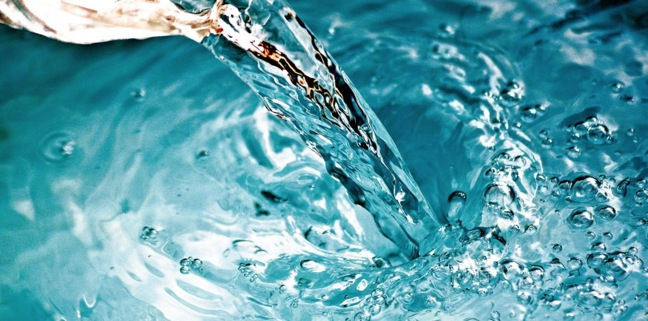
The use of water in this sacrament speaks to us about life. Without water, we die. Likewise, without God in our lives, we die, not in a physical sense, but in the spiritual and eternal sense. The water of Baptism, therefore, show God’s life quite literally being poured over, around and into us. Moreover, water speaks both of cleansing and of power. In a sense, water is a destructive force. In Baptism, this refers to our being cleansed of sin and the consequences of the original sin of our fist parents being destroyed and cleared away. In its place, the water brings us the power of God in the Holy Spirit to make us holy and to energise us for mission.
Other symbols
In a regular Baptismal ceremony, there are a number of other symbols and gestures that help tease out the meaning of the Sacrament.
A person is usually anointed with the sacred oil of Chrism, perfumed olive oil used to consecrate sacred objects,places and peoples for millennia. It is by this that we sometimes refer to someone being “christened” – they are anointed, just as Christ (a title which means the “Anointed One”) was anointed with the Holy Spirit (see Luke 4:16), so we are marked as belonging to Christ, and, by being baptised people, become sacred and part of God’s Kingdom and Family.
A candle is usually lit for the person who has been baptised, the light taken from the Easter or “Paschal” Candle. This candle, lit at Easter time, first of all reminds us that we have a share through Baptism in the life of the Risen Jesus – we will rise again with him! As a light passed on (sometimes to godparents and parents to hold for a little child), it also reminds us that Christ is the Light that guides us throughout our life’s journey.
The newly-baptised person or child is often dressed in a white garment – sometimes and ‘alb’ (the long white garment the priest wears under his other vestments) or a white shawl. The traditional christening gown in which a baby is wrapped is for this. It represents the new life that the person has “put on”. It is a reminder that we have become someone new by now being a child of God and a part of God’s family. Many of the images and visions of heaven we read in the New Testament (see Revelation 7:9) show the saints in heaven dressed in white robes, a powerful image of who and what we are called to become by being baptised people!
Click here to find out more about adult baptism and the process of RCIA by which an adult is received into the life of the sacraments.